DataByte
Resources

How the platform actually works, written by the team that built it.

No gated PDFs, no recycled analyst quotes. Engineering essays, real reference architectures, and concrete deployment patterns you can use whether you adopt DataByte or not.
DataByte resource centre with engineering guides and documentation
Reference architectures

The whole platform, at the level of detail an architect asks for.

The homepage draws the platform in the seven layers a reader can take in at a glance. These two go further: every module, what enters and leaves, what ships in every deployment, and what it all runs on.

The DataByte platform, end to endSignals arrive from databases, warehouses, SaaS applications, streaming systems and files. Fourteen modules work on them across four stages. Get data in: Data Ingester and Integration Connector. Make it useful: Transformer, ML Studio, Forecaster and Anomaly Detector. Put it to work: Data Insider, Analytics, Sherlock, ProcBot and DataOps. Keep it trusted: Semantic Ontology, Governance Fabric and the Data Catalog. Results leave as APIs, dashboards, reports, alerts and webhooks. Every deployment has one security model with row and column level access, one catalogue covering every asset and every lineage hop, one chained audit trail, and the SMART framework of SLAs, rules, actions and traceability. Underneath all of it the platform runs on your own infrastructure in any cloud, your region, on-premises or air-gapped, is independently assured against SOC 2 Type II and ISO 27001 and assessed for GDPR, and makes no outbound call back to DataByte. Exports happen when you run them, and every one is logged.SOURCESDatabasesWarehousesSaaS appsStreamingFilesOUTPUTSAPIsDashboardsReportsAlertsWebhooksGET DATA INData IngesterBatch, CDC, on demandIntegration Connector2,000+ connectorsMAKE IT USEFULTransformerSpark, canvas or codeML StudioPrep to a live modelForecasterDemand, capacity, cashAnomaly DetectorDeviation on live streamsPUT IT TO WORKData InsiderAny source as an APIAnalyticsDashboards and reportsSherlockRoot cause, automatedProcBotGoverned automationDataOpsHealth, SLAs and driftKEEP IT TRUSTEDSemantic OntologyBusiness objects, governedExplainability FabricRecorded and chainedData CatalogAssets and lineageDataByteGoverned by constructionIN EVERY DEPLOYMENTOne security modelRBAC, row and column levelOne catalogueEvery asset, every lineage hopOne audit trailEvery action, chainedSMARTSLA, rules, actions, traceabilityYour infrastructureAny cloud, your region, on-premises, air-gappedIndependently assuredSOC 2 Type II, ISO 27001, GDPR assessedNothing calls homeExports are yours to run, all of them logged
Every module, in the stage it belongs to.

Every module in the stage the product navigation puts it in, with the sources it reads and the outputs it produces on either side. Underneath, what arrives in every deployment regardless of which modules are switched on, and the infrastructure the whole thing stands on.
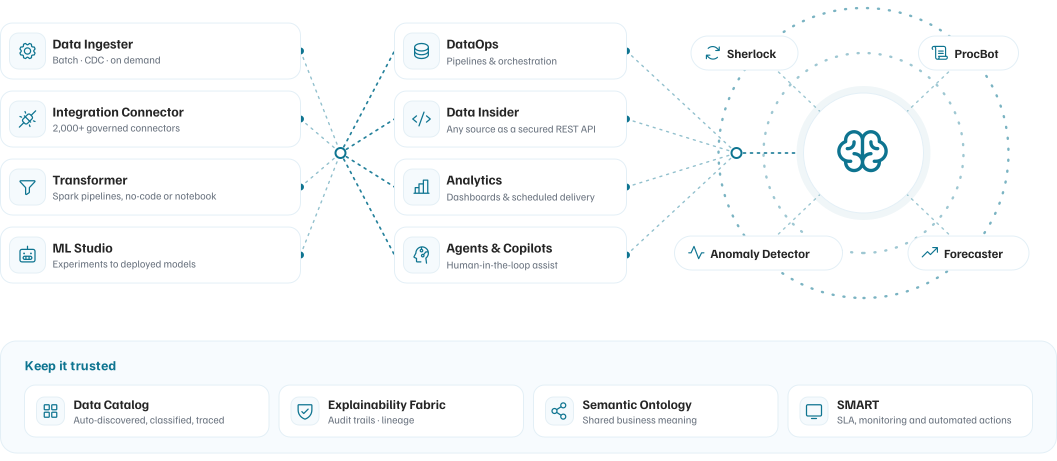
The DataByte platform on one canvas. Data Ingester (batch, change data capture, on demand) and Integration Connector (2,000+ governed connectors) feed Transformer (Spark pipelines, no-code or notebook) and ML Studio (experiments to deployed models). Those converge on DataOps (pipelines and orchestration), Data Insider (any source as a secured REST API), Analytics (dashboards and scheduled delivery) and Agents and Copilots. Everything then feeds one intelligence core, ringed by Sherlock, ProcBot, Anomaly Detector and Forecaster. Under all of it sits the governed layer, Keep it trusted: Data Catalog (auto-discovered, classified, traced), Explainability Fabric (audit trails and lineage), Semantic Ontology (shared business meaning), and SMART (SLAs, monitoring and automated actions).
The same platform, drawn as territory.

The same platform as a flow: engineering modules feeding insight modules, converging on one intelligence core, with the governed layer holding underneath all of it.

Working on something specific?

We'll share the architecture guide most relevant to your stack before your demo, so we can talk concrete in the session.