
Three decisions, made well, instead of eight you have to make yourself.
Instead of stitching eight tools together and calling the result a platform, we made three architectural decisions once, and built an integrated platform that shares them.
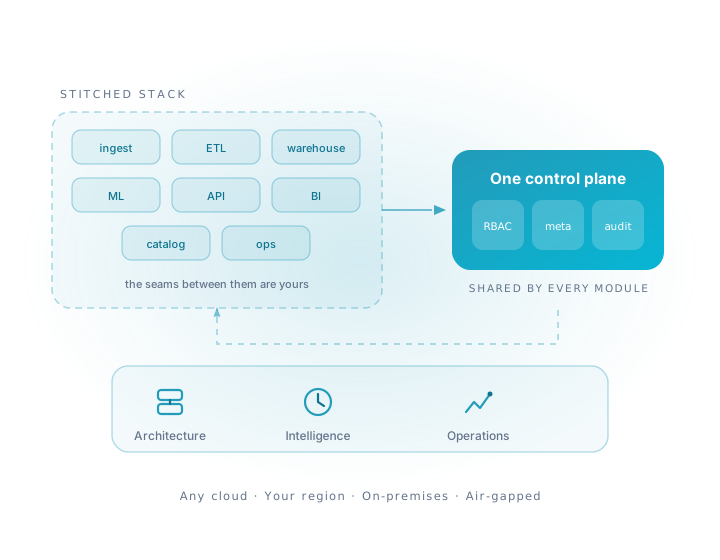
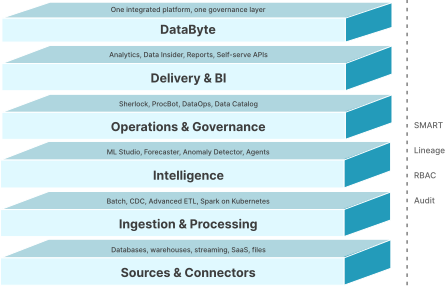
Six layers. One stack. One set of policies.
Sources feed ingestion; ingestion feeds processing; processing feeds intelligence and delivery. SMART governance and the Data Catalog span every layer from day one, not bolted on at audit time.
Every layer shares the same RBAC, the same observability, and the same audit trail, so lineage survives contact with production.
Unified by architecture, not integration.
One data model, one governance layer, one RBAC. An integrated platform, built together from the start.
- An integrated platform on a single Spark + Kubernetes foundation.
- One RBAC model, platform, module, row, and column.
- One catalog. Lineage across every transformation, automatically.
- Cloud-agnostic: AWS, Azure, GCP, or on-prem; data-plane / control-plane split.
AI that ships inside the platform.
ML Studio, Forecaster, and Anomaly Detector cover the full ML lifecycle. A growing library of agents lets teams converse with the platform in plain English.
- Talk to Your Data: natural-language queries over SQL, NoSQL, S3, APIs.
- ETL/ELT Designer agent turns requirements into deployment-ready pipelines.
- 25+ time-series algorithms; one-click model deployment as REST APIs.
Governed, observed, and self-healing by default.
The SMART framework, SLA, Monitoring, Actions, Rules, Traceability, is embedded in every module. Sherlock closes the loop with autonomous remediation.
- SLA alerts that fire before the breach.
- Sherlock diagnoses incidents across live telemetry and historical failures.
- Automated PII tagging and classification in the catalog.
- Autonomous root-cause analysis with validated remediation.
- Cross-module audit trail for GDPR, PCI DSS, and SOX reporting.
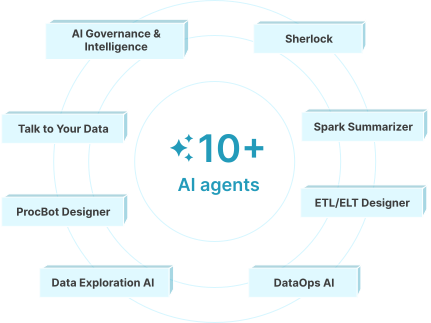
Converse with the platform. A growing library of agents.
The agents aren't a separate product. They reach into every module, ingestion, transformation, ML, operations, and take instructions in plain English. New agents ship with the platform regularly.
- Talk to Your Data: Plain-English queries over SQL, NoSQL, S3, Cassandra, and APIs.
- ETL/ELT Designer: Describe the requirement, and the agent ships a deployment-ready pipeline.
- Spark Summarizer: Turns verbose Spark logs into "what ran, failed, was slow, fix this."
- ProcBot Designer: Describe a process, and the agent generates the working script in bash, Python, Terraform, or Ansible.
- Sherlock: Autonomous agents help with not only problem discovery but throughout the process from problem detection to auto-remediation and closure.
- DataOps AI: Ask about pipeline health and SLAs; answers come from live telemetry.
- AI Governance & Intelligence: AI agents continuously enrich metadata, classify sensitive data, monitor compliance, and generate governance insights across enterprise data assets.
- Data Exploration AI: Describe the requirements in natural language, and the agent generates the transformation code behind the scenes to produce the output.
Three kinds of automation. One audit trail.
Moving data between systems, reacting to an event, and running a process that waits on a person are three different problems with three different runtimes. Most platforms give you one and you license the other two, then spend the project reconciling three audit trails that disagree.
System to system
High volume, governed, data-shaped. Two thousand connectors, a visual builder, and credentials that resolve at run time from the store you choose.
Built by an integration engineer.
Something happened, do this
Event-driven and cross-application, including the actions that are not data at all: notify a channel, open a ticket, call an endpoint, wait, branch.
Built by an operations or business automator.
Work that waits on a person
Long-running and stateful, with human tasks, approval gates, timers, escalation and service levels. It survives a restart and it remembers where it was.
Built by a process owner.
All three run under the same rules.
One catalogue, so every one of them sees the same definitions. One policy model, so a route, an automation and a process are all bound by the same access rules. One audit trail, so when an auditor asks who moved a number, the answer does not depend on which of the three did it.
Most failures are ones somebody already anticipated.
Anomaly Detector learns what a normal run looks like for each pipeline and flags the ones that stop matching. Sherlock walks the decision tree you configured, isolates the component that failed, triggers the remediation, and verifies recovery before the incident is closed.
Between them they cover the failures you can describe in advance. Every platform has a story for those.
Then there is the one nobody wrote a rule for.
Sentinel investigates across the estate and reasons about what it finds. It returns a root cause with the evidence behind it, and every finding traces back to the signal it came from.
Incident patterns it has seen before are closed end to end without waiting for a person.
Anything that would alter a running system waits for an approval, scoped to what the change can reach.
Sentinel comes from Opstral and is included with the platform.
SMART, the framework embedded in every module.
Governance isn't a separate tool or a separate project. The same five primitives run inside every module of the platform. That's the only way compliance reporting becomes a report instead of a project.
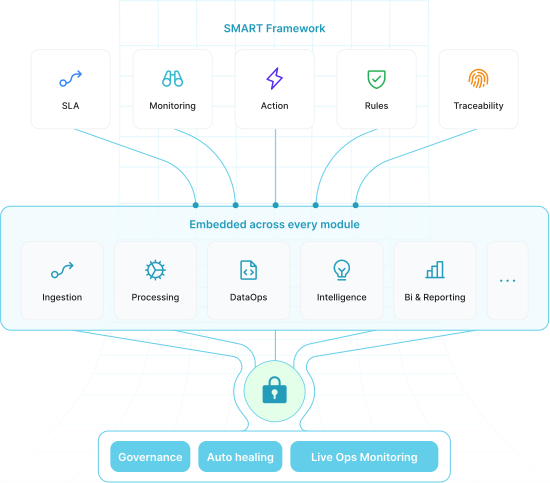
- SSLA
Per-pipeline thresholds, alerted while there is still time to act.
- MMonitoring
Continuous lifecycle monitoring across executions.
- AActions
Automated responses: notify, retry, escalate, reroute.
- RRules
Business and technical rules enforced at the platform level.
- TTraceability
Cross-module lineage and audit trail, source to consumer.
Four ways to build this. Here is where each one costs you.
Nobody chooses a data platform against a single product. They choose an architecture, and then live with what it made expensive. Below is what each of the four does well, and a second block naming the places we are the weaker option. Every one of those is something a buyer finds in diligence, so we would rather say it first.
| Assemble it yourself | One cloud, natively | Single-vendor suite | DataByte | |
|---|---|---|---|---|
| What the platform does | ||||
| Who owns the joins between capabilities | You do. Every connection, and every one of them again at upgrade. | You do, within one provider’s services. | The vendor, though often across separately acquired products. | Included. One codebase, one upgrade path. |
| Governance | Per tool, reconciled by hand. | Strong inside the cloud, thinner at its edges. | Central, where every module is genuinely the same lineage. | One catalogue, one lineage graph, one audit trail, 70 executable controls. |
| Shared business meaning | Rebuilt separately in each tool. | Usually treated as a BI-layer concern. | Varies by module. | Semantic Ontology. One definition every module and agent reads. |
| Lineage across the whole path | Reconstructed by hand when an auditor asks. | Within that cloud’s own services. | Per module, sometimes joined. | End to end, recorded as the work happens. |
| AI agents | Added on top, usually holding their own credentials. | Per-service assistants. | The vendor’s assistant, per module. | 40 copilots and Agent Studio, answering inside the permissions of the person asking. |
| Air-gapped and sovereign deployment | Possible, tool by tool, if every tool supports it. | Rarely. Running elsewhere is the opposite of the model. | Some offer it, often on an older release train. | Any cloud, your own region, on-premises, or fully air-gapped. |
| Commercial model | One contract per tool, renewing on different dates. | Consumption, per service. | One vendor, commonly licensed per module. | One contract. Modules, connectors and copilots included. |
| Getting back out | Negotiated separately with each vendor. | Egress costs, and services to rewrite. | Proprietary formats are common. | Apache Spark, Kubernetes, Open Policy Agent, Apache Camel YAML. |
| Where we are behind | ||||
| Production installed base | Each tool has thousands of deployments. | Tens of thousands. | Thousands, accumulated over decades. | 10+ enterprises. This is the weakest row on the page and we are not going to dress it up. |
| Public customer references | Published case studies for every tool. | Extensive. | Extensive. | None published. No customer has given written consent to be named, so there is no list, gated or otherwise. References happen under NDA on a call. |
| People you can hire who already know it | A large market per named tool. | A large certified market. | Established certification programmes. | Small. Your team learns it with ours, and that is a real cost to plan for. |
| Third-party ecosystem | Mature marketplaces and integrations. | A large marketplace. | A partner network and a marketplace. | None yet. No marketplace, no partner network, no implementation firms. |
| Analyst coverage | Covered in every category it spans. | Covered. | Covered. | No analyst placement. |
The first three columns describe approaches, not products. We do not publish named competitor comparisons: every such claim goes stale, and the tools a buyer is most likely to be weighing are ones this platform connects to rather than replaces.
Want the technical walk-through?
We'll show you the modules, the SMART framework, and how lineage actually works end to end.