
Your business as objects the platform can act on.
Orders, Customers, Shipments, and Network Elements become versioned, governed business objects. Each one carries its own relationships, generated APIs, workflows, lineage, and security policy. Every team reads the same definition.
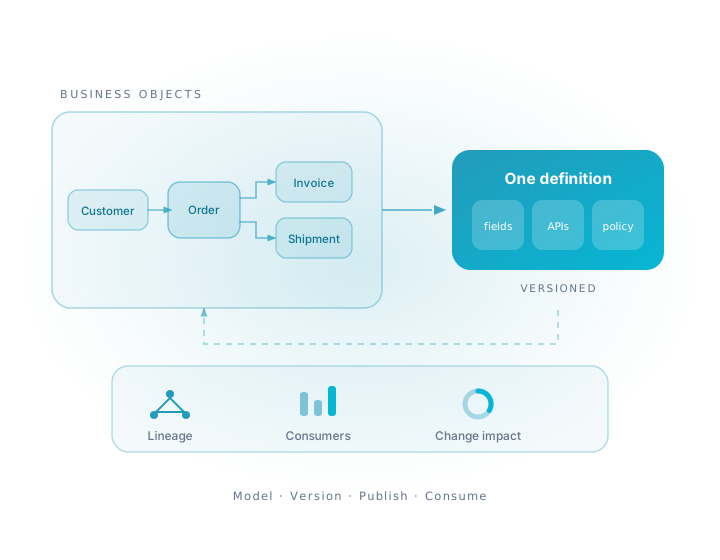
Model the business the way the business talks.
A table is an implementation detail. "Customer Order" is not.
The Semantic Ontology lets the people who own a domain define it in the language they already use: an Order, a Product, a Shipment, a Network Element, each one a first-class business object, where today it is a join someone has to remember.
Underneath, every object stays bound to the real schemas and tables it is drawn from, across as many source systems as it takes.
The business gets a concept it recognises. Engineering keeps the physical model. Neither side has to translate for the other in a meeting.
See how the business actually hangs together.
Objects are connected by named, directional relationships: a Customer places an Order, an Order contains an Invoice, a Product is provisioned on a Network Element.
The topology view renders that map across every domain at once, so the shape of the business is something you can look at. Today it lives in the heads of three people.
Because the relationships are declared rather than inferred from joins, they survive schema changes, and they are what lets an agent or an API traverse from a customer to their unpaid invoices without anyone writing the path by hand.
A model with versions and a release process.
Objects are versioned semantically and move through draft, review, published, and deprecated.
Before a change is activated, Compare shows exactly what was added, removed, modified, or renamed against the previous version, so a rename that would break ten downstream consumers is caught before it ships rather than after.
Every change lands in a semantic change feed with the actor and the timestamp attached, filterable by objects, relationships, or APIs. Model governance stops being an email thread.
Objects the rest of the platform reads from.
A modelling tool produces a picture. An ontology produces behaviour. Because every object is defined once and governed centrally, the rest of the platform reads from it directly instead of keeping its own copy.
Each object exposes generated, versioned endpoints, so a consuming team integrates against Order rather than against four tables and a join.
Data InsiderTable and column-level lineage per object, showing sources, pipelines, consumers, and column mappings in one view.
Data CatalogState transitions, actions, and workflows attach to the object itself, so business rules live with the definition rather than in the tool that happens to run them.
ProcBotAccess, masking, and PII policy are set per object and inherited by every API, pipeline, and report that reads it.
Security and trustTransformation pipelines reference the object, so a schema change surfaces as an impact assessment rather than a 3am failure.
TransformerPlain-English questions resolve against defined objects and relationships instead of guessing at table names, which is what makes the answers reproducible.
The agentic layerAn ontology of your business, inside your own walls.
An ontology is the most sensitive artefact you will ever build. It is not your data, it is the map of how your business works: which entities exist, what they are worth, how they connect, and who is allowed to see them. That map is exactly what you least want sitting in a vendor's cloud.
DataByte's Semantic Ontology runs on the same footing as the rest of the platform: your Kubernetes, your cloud, or fully air-gapped on your own infrastructure, with the built-in agents reading it from self-hosted models. Nothing about how your business is structured has to leave the building for you to get the benefit of modelling it.
Works with the rest of the platform.
Every platform action is recorded with what authorised it, cryptographically chained so later alteration is detectable, and evaluated continuously against executable compliance controls.
Read moreOne place to find any data asset and see where it came from. Automated discovery, cross-tool lineage, business glossary, classification, and automated PII tagging.
Read moreMove data in at any cadence: scheduled batch, on demand, or change data capture that streams every insert and update as it happens.
Read moreBring your messiest domain.
We will model it as objects on the call and show you the topology, the generated APIs, and the lineage behind them.